Showing posts with label Tom Palmer. Show all posts

Thursday, September 20, 2018

Panel Discussion: Great Penciller / Inker Teams of the Bronze Age!


Redartz: The annals of the Bronze age are filled with comic tales illustrated by immensely talented creators. Many of those creators worked at times as solo artists, laying down pencils and then inking over their own work. Names like John Buscema, Barry Smith, Joe Kubert, John Byrne- all did notable work in this manner. But more often, a penciller was paired up with another artist, an inker; who would enhance  the pencilled art with inked lines in a blending of two individual artistic styles. Some pairings, predictably, were more successful than others. 

Today we will consider  the more effective examples. Which pencillers worked the best with which inkers?  Some teams have become iconic over the course of comics history; but that can be a subjective question. Here are four of my top teams, just to get things started.

Neal Adams / Dick Giordano

Talk about a history-making combination. Adams and Giordano were the hands behind many of DC's best stories and characters, producing truly classic tales of Batman, Deadman, Green Lantern and others. Here's a dramatic opening page from one of the Green Lantern solo back-ups in Flash comics, circa 1974...

Flash 226


John Byrne / Terry Austin

This could be, possibly, the single greatest artistic team in comic art history. In my opinion, it very well may be. Byrne and Austin made magic out of whatever they worked on together. Their art styles were flawlessly matched. Many of my top favorite comic stories came from their drawing boards, including this incredible panel with Kitty Pryde and Wolverine.  
Uncanny X-Men 131


Sal Buscema / Klaus Janson

Sorry about the black/white reproduction, the "Essential Defenders" doesn't feature color. But it does feature some fabulous stories, several of which are by Sal and Klaus. Janson's heavy shadows and detailed linework add solidity to Sal's pencils, and the results are spectacular.

Marvel Treasury Edition 12


Gene Colan / Tom  Palmer

These two have been paired many times, on many books; due doubtlessly to their absolutely perfect melding of styles. Palmer's polish beautifully enhances Gene's cinematic pencils, anytime, anywhere. And this page highlights two characters intimately associated with them...
Dr. Strange 14


Next, here's two examples of rather unusual pairings that  I found appealing...


 Carmine Infantino and Klaus Janson

Infantino seems to channel a bit of his old Silver age Flash skill here, showing off DD's aerial technique. And speaking of technique, you can't beat Janson's moody inks here. A different look, but very solid. 


Daredevil 152


Barry Smith and Frank Brunner

Two excellent artists, known for highly detailed work. One might think they wouldn't quite blend visually, but this page is excellent. You get Smith's design sense and Brunner's finesse. That last  panel close-up is incredible.

Marvel Premiere 4


Each of the above-mentioned artists also did phenomenal work with other artists, and there are dozens of others to add to the list. That's where you come in. What other great combos can you name? How would you rank them? Which pencillers do you feel looked better with their own inks?  Which inkers most effectively meshed with a variety of pencillers? What unorthodox pairings of pencil and ink found approval in your eyes? Sharpen your pencils, open that ink bottle and let's talk art!

Saturday, May 27, 2017

Chew the Fat: The Evolution of the Avengers through the Bronze Age!

Martinex1:  A couple of weeks ago we discussed the span of the Bronze Age (starting with the first 15 cent issues on sale in May of 1969 and ending 16 years later in May of 1985).   Those are the BitBA parameters for these ongoing discussions about Bronze Age comics and the evolution of those special books.   Last time we looked at the first Marvel super team, The Fantastic Four, and this time around we will look at their premiere team The Avengers.

 I think there is more variety in this sampling with many corner boxes, some subtle (and not so subtle) logo changes, an array of team lineups, and some fantastic artists.

The team's 66th issue is a wonderful way to kick off the run, with John Buscema's cover art and Iron Man's swoop nicely matching the curve in the logo.  It has the corner characters designed by Gene Colan who just finished his run, and interior art by Barry Windsor Smith with a story by Roy Thomas.   In 1985, the final issue shown also has a cover by John Buscema, this time with Tom Palmer instead of Sam Grainger inking, so we make a full circle on the art even though Roger Stern would be the writer by that time. Note the appearance of Spidey in his black garb; somehow that seems appropriate for the end of an era.  In between there is quite a bit to take in - take a look.


Avengers #66; On Sale May 1969 for 15 cents

 Avengers on sale May 1970, 1971 and 1972.

  Avengers on sale May 1973, 1974, and 1975.

  Avengers on sale 1976, 1977, and 1978.


.
  Avengers on sale may 1979, 1980, and 1981.

   Avengers on sale May 1982, 1983, and 1984.
Avengers #258; on sale May 1985 for 65 cents.
So what do you think about the mighty mainstays of the Marvel milieu?  How did they fare along the Bronze way?  Did they improve or devolve?   What are your takeaways from this little experiment?

Next time around we will tackle a solo character with a storied career!   Cheers and have a great long weekend!


Monday, April 3, 2017

Panel Discussion: Gene "The Dean" Colan

Martinex1: Recently Redartz and I have shared our appreciation for John Romita and Sal Buscema; today I want to discuss another of my favorite artists from the early Bronze Age at Marvel: Gene Colan!

"Gentleman" Gene as Stan Lee would sometimes refer to him, had one of the most recognizable art styles of the era.   At a time when sticking to the company's model sheets was important in building the recognizable characters that would become icons,  Gene Colan demonstrated a flair that was uniquely his own.  He used motion and shadows and a love of cinema to bring a different technique to the style and storytelling around the heroes.   Often teamed with inker Tom Palmer, Colan's dark nights seemed darker, the shadows seemed more dangerous, and the mysteries more urgent.  The characters were limber and wild; the facial expressions were detailed and varied; the mood was treacherous and bleak.   I say there was a true "art" to what Gene Colan accomplished. Gene started his comic career in 1948 and one of his first cover works was on Captain America's Weird Tales way back in 1950.   That was just the start as he worked well into the 2000s.


Gene Colan, whose images were not traditional or mainstream in my eyes, was not assigned B-list stars when Marvel got rolling under Stan Lee.    Quite the contrary, he was in charge of many Marvel newcomer titles from the late Silver Age (1967 and beyond)  that were taking the world by storm.  He had his hands on Iron Man, Daredevil, Captain Marvel, Sub-Mariner, Doctor Strange, Captain America, and even the Avengers. He was the first artist to draw the Guardians of the Galaxy.   He was prolific as well as talented.  And in my opinion, his early work was just as influential as Jack Kirby's art.  They were vastly different in their approach and styles but they each offered a sense of dynamic energy that has lasted until today.   In the late 70s, Colan would also take on Dracula and Howard the Duck. He intermittently had stints with DC, and when leaving Marvel in the early 80s he worked on characters like Batman, Jemm Son of Saturn, and Silverblade.


Gene Colan's work was amongst the first I recognized.   I was blown away by his "Tales of the Watcher" back up stories in Silver Surfer and soon after was mesmerized by his rendering of Mr. Hyde, Cobra, and the Jester over in Daredevil.  I was exposed to those issues at an early age so they remain amongst my favorites, but I do believe that Colan made an impression on me.  He made me feel the danger, irony, and kinetics of the super-hero tales.

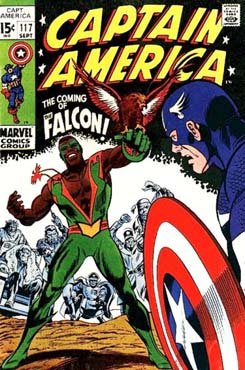
Some may not like Gene's penciling style; like I have said it is unique.   Whereas other artists have played with the body's flexibility and positions, Gene was able to make the impossible seem real and reasonable.  I still think his Daredevil is the best.  If you look at Colan's layouts and motions of the characters, few artists attempt those actions. I will agree, however, that not every book is meant for Colan's talent; Captain America and the Avengers are amongst his lesser works (though still great). I think that is so because those books' more upbeat mood and optimism did not always align with Colan's shadowy style.  The figures within, however, are just fantastic.   Take a look at Cap resting on the couch.  And let's not forget that he co-created Sam Wilson, the Falcon.


In his later years, Gene Colan continued to work and also drew commissions for lucky fans.  I did not feel Gene's talent subsided, unlike others in his field.   He could still create a moody piece.   Take a look at his work though the Marvel years as well as some of his commissions.  


In case you don't think Gene Colan had a sense of humor, take a look at the following. I particularly find humor in the fact that Colan got that word onto the cover of a mainstream Daredevil comic book.  I guess the Comics Code Authority was not watching too closely - see the marquis just below DD's left hand. 


Unfortunately, Gene died in 2011.  But he left behind numerous works that demonstrate a type of talent that is rarely reached and seldom passed.  


You Might Also Like --

Here are some related posts: