Sunday, September 24, 2017

Sunday Rerun: What Ifs from When Then!


Martinex1: Back in the day of the Bronze Age Babies site, the hosts Doug and Karen invited us to contribute short reviews of comics that we enjoyed.   Here today I share a few of my quick reviews from April 20, 2015.  I've added a few extra notes as well.  I hope you enjoy these reruns today!  Cheers!


What If? #6 (December 1977)
"What If the Fantastic Four Had Different Super-Powers?"
Roy Thomas-Jim Craig/Rick Hoberg/Sam Grainger
 
In typical What If fashion, the Watcher explores possible outcomes of the fateful flight and cosmic ray impact in the origin of the FF. The artwork is serviceable at best but the story and characterization move briskly. In what may be the first overt linking of the foursome’s personality to their powers, we get Big Brain, Dragonfly, Mandroid, and Ultra Woman. Fairly standard adventures ensue. The highlight is the rather 1950’s horror inspired lunacy of Reed’s floating bodiless brain. Only Marvel could have vengeful dialogue like, “What’s wrong kiddies? You got something against Grand Funk Railroad!”  Who needs Dr. Doom?

Martinex1 (update): This was within the first ten Marvel comics I ever purchased.  I was an early fan of the FF and was really intrigued by this What If.  I felt that Ben Grimm really shined in this issue as he became the field leader. There was an emotional pull as Reed dealt with being reduced to a brain floating in a series of tubes filled with life sustaining liquid.   I maintain a nostalgic desire to see this version of the FF appear again and actually battle the mainstream family in the way the cover depicts (alas that never happened in the book).  I mentioned in my early review that the art was "serviceable" but I actually like Jim Craig's quirkiness here; the only other work of his that I know was on 3-D Man in Marvel Premiere.  And in retrospect I am happy to see that Sam Grainger, one of my favorite inkers, was involved. 


What If? #7 (February 1978)
"What If Someone Else Had Become the Amazing Spider-Man?"
Don Glut/Roy Thomas-Rick Hoberg/Sam Grainger

The ol’ Watcher is at it again, sharing alternative tales of Spidey’s origin with the icon’s supporting cast being bitten by the radioactive spider. We get three abbreviated stand alone and tragic tales in which Flash Thompson, Betty Brant and John Jameson are the recipients of that fateful bite. The costumes are repetitive at best, and reflective of 70’s goofiness at worst. Spider Jameson (yes that is his moniker) dons a helmet reminiscent of the TV Captain America. No great insights here, and the ultimate outcome on all three worlds is predictable and melodramatic. Makes you long for Spider Ham!

Martinex1 (update):  This is the weakest of the issues reviewed today, but it was actually a nice primer for a kid who was not that familiar with Spider-Man's origin at the point I read this.  I have seen comments on other sites that abhor Betty's Spider-suit, but I liked that costume as many heroines don't hide their face and I thought this was strikingly different that way.  Why don't the females hide their secret identities better? Wasp, Sue Storm, Scarlet Witch, Wonder Woman etc are all fairly exposed.


 What If? #20 (April 1980)
"What If the Avengers Had Fought the Kree-Skrull War Without Rick Jones?"
Tom DeFalco-Sal Buscema/Alan Kupperberg/Bruce D. Patterson

In a nice companion piece to the Kree-Skrull War, the Watcher investigates a world in which Rick Jones dies at the hands of Ronan so he is never employed as the “deus ex machina” for that conflict’s conclusion.  The alternative action which includes an armada of heroes joining the fracas could have been explored more thoroughly.  But Alan Kupperberg’s art is better than expected, and the way the story deftly hits on original keynotes of the epic is admirable.  Hard to believe that this enjoyable “imaginary” diversion was somehow the impetus for the morass that was Avengers #200.

Martinex1 (update): I actually thought that in some ways the all out battle with Earth's heroes was a more palatable conclusion than the way Rick psychically created manifestations of heroes in the original story.   I am curious as to why the coloring had Daredevil (below) in black.  The reference I make to Avengers #200 is that editorial decided to change that Avengers story as this issue had a similar ending as to what they had planned.  My understanding is that the Supreme Intelligence was going to have some influence on Ms. Marvel's mysterious pregnancy but they had to shoehorn in Marcus / Immortus so it wasn't redundant.  Whatever the cause, that did not work out well at all. 


Avengers #169 (March 1978)
"If We Should Fail... the World Dies Tonight!"
Marv Wolfman-Sal Buscema/Dave Hunt

This fill in issue pits Iron Man, Cap, and the Panther against a megalomaniac with a weak heart and a diabolical plan. The story devolves into a Justice Society like adventure as each Avenger explores the globe searching for a portion of a world destroying bomb. The plot is weak as the heroes confront men and beasts in their time hindered quest. The story includes rather stereotypical antagonists and a penchant for melodrama. The real star is Sal Buscema with some incredibly clean lines and spot on Avenger action. And who can resist the crossword drama of the opening splash?

Martinex1 (update):  The dreaded deadline doom caused Marvel to publish this stock issue right in the middle of the Guardians of the Galaxy and Korvac epic.  But I have to say that I really think Sal Buscema's art in the issue was so solid. His Captain America and Black Panther brought me back to the classic days when he first worked on the book. The story is weak and as I stated is more reminiscent of an early DC book.


Saturday, September 23, 2017

Chew the Fat: Charts, Graphs, Power Rankings and You!


Martinex1: How much did the heroes' and villains' power class play into the enjoyment of the character and story for you?  Were you a collector that liked to compare and contrast heroes' strengths and weaknesses?   Did the advent of books like The Official Handbook of the Marvel Universe and DC's Who's Who add to your comic enjoyment or did it change the way you looked at characters and collecting?

Did you care if Ghost Rider was less strong than Thundra, on an equal level with Giant-Man, and more powerful than Captain Britain?  Super-Heavyweights down to the Un-powered - did it matter?  Take a look at the slick Marvel strip to the left to get your bearings.

How did knowing strength capabilities of your favorite heroes detract from or add to your comic collecting experience? Did you and your friends debate the details like others might discuss baseball batting statistics?  Did the ranks and data emerge in the 1980s or were there examples prior?

Were you into gaming?   Did you develop charts and graphs to track the heroes' durability, strength, intelligence, power, speed, and endurance?

Did Marvel and DC get it right (in your mind) when it came to classifying heroes and villain?   Did the activity enhance or diminish the overall enjoyment of the reading thereafter?

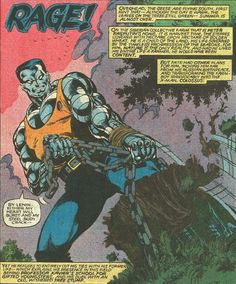
Did you see shifts in power and strength in characters?  Was that a normal evolution or was it the result of inadequate writing?   Should Colossus have struggled pulling out a tree stump or was John Byrne right to be miffed with Chris Claremont about that scene?  Why was Stiltman a threatening villain in the Silver Age but a punchline in the Bronze Age?

Today let's Chew the Fat about power ranking, strength charts, and all of the data that goes along with it as part of collecting!  Cheers!


Friday, September 22, 2017

Show and Tell: Fan Art, or Let's See Your Drawings...


Redartz:  In the course of our comics fan careers, many of us have tried our hands at writing/drawing some comics ourselves. Perhaps it was tracing the figures on a favorite cover. Maybe we were  covering our schoolwork with sketches of favorite characters. Some may have actually tried to create actual stories featuring some notable heroes and villains. And some may have created stories and characters all their own. All are satisfying creative outlets for the inspiration provided by our four color hobby.

And in recent years, the growing popularity of  "adult coloring books" adds a whole new opportunity to participate in comic creativity. Check these out:


 Today we will look at some examples of just such 'fan art'. To begin with, here is a clever story courtesy of our friend Pfgavigan. Enjoy!


Redartz:  I've designed many comic-related cards for my wife, for Valentine's Day and other occasions. Also, every year  I try to design a greeting card for the holidays. Sometimes they are serious in tone, other times lighter. Here are two which reflected a bit of my comics affection (some might call obsession). 


How about the rest of you? Have you made some drawings, done a few sketches, made a comic? If not, given the chance, what kind of character would you most like to work with? What kind of story would you tell? Unleash your inner Englehart, your buried Byrne; tell us all about it.

Thursday, September 21, 2017

Rank and File: Six Marvel Characters That Deserved Bronze Age Embracing!


Martinex1: I read an article from the late 1980s that lamented the fact that new comic characters were being created when existing shelved characters could have sufficed.  It posed the argument that many second tier characters under the proper creative spirit could have been guided to be a reasonable threat in terms of a villain or a noted hero.

The Scourge of the Underworld story line would never have had to exist if characters were treated as three dimensional material. Likewise was a character like Darkhawk necessary while Nova waited in the wings?  Or as was asked in previous columns, was Dr. Doom the only serious megalomaniac available?  Why was he reduced to such common use that he had to tackle the likes of Dazzler?

But the situation was nothing new, going all the way back to the Golden Age of comics, characters were created and disposed of while others jumped to super-stardom.  And redundancy of powers was never the sole defining criteria for approval or dismissal - just ask Captain Cold, Mr. Freeze, and Killer Frost.

Today, I have created a list of six Marvel characters that back in the Bronze Age I wanted to be more successful and in use.   For whatever reason they fell to the second or third tier in popular employment and never maintained a headliner status (if they were ever offered a lead role at all).  I see great opportunity in their personality, power, design, and attributes.

My question is why weren't they used more?  And why weren't they successful?   For that matter, do you agree that they should be on the list?  Who would you recommend as an underplayed creative commodity?

Feel free to join in and rank characters that need to be embraced!

1) Black Goliath / Giant-Man / Bill Foster: Introduced way back in Avengers Vol 1, #32, Dr. Bill Foster had been hanging around in various guises throughout the Bronze Age.  After augmenting Pym's formula he became a hero in his own right and had a short-lived series called Black Goliath.   Following that run, he made appearances in The Champions, and later teamed up with the likes of Spider-Man and the Thing.  His most notable appearances in my opinion were in Marvel Two-In-One where his friendship with the Thing really helped show his character as a trustworthy friend, generally good guy, somewhat careful hero, and decent poker player.  In my opinion, in his last incarnation as the new Giant-Man he should have been the go-to powerhouse for brains and muscle for teams like the Defenders and the Avengers.   Alas, he never seemed to get a full chance and the last I heard he was killed off in a modern adventure.  I found it interesting that in an issue of What If (see the Giant-Man panel below), he was offered a role in the Fantastic Four to replace an injured Thing; in that imaginary tale Foster received the fame, accolades, and notoriety he deserved.  I wish that would have happened in the mainstream Marvel stories.


 2) Mister Machine / X-51 / Machine Man / Aaron Stack:  Machine Man is such a strange creation as originally envisioned by Jack Kirby first in the 2001: Space Odyssey series and then in the eponymous Machine Man run in the late 1970s.  Alternatively known as Mister Machine and X-51, the living robot sought to live a normal life and adopted the name of Aaron Stack while living in suburbia and working a job as an insurance adjuster. His body is made of steel with limbs that extend similarly to those of the children's cartoon character Inspector Gadget.  But I found the character intriguing as he continually sought some meaning to his life.   Even more so than characters like the Vision, Machine Man was constantly distant from human emotions despite thorough introspection.  Though he sought to understand, the world remained uniquely foreign to him. When Steve Ditko took over his series, that strangeness became even more apparent as he sacrificed life and limb despite really understanding what he was fighting for other than some programmed "correctness."  I enjoy this character and I would have liked to see him used more.   Despite the X-Men being designed for mutants, I think this oddball would have fit in well as that team's version of the Vision.  What could be more "mutant" than a conscious mechanism?  However, the character never reached his potential.  He appeared in a mini-series back in the 80s, is used intermittently, and somewhat relegated to the trash heap.


 3) Thundra:  The time traveling Femizon from the 23rd century city of Greater Milago (Milwaukee- Chicago) may seem silly but remains one of my favorite characters from the Bronze Age.  Her adventures with the Thing are of particular interest.  She was a great foil for Ben Grimm and despite her surface characterization as a "strong woman," she developed into a character that I continually enjoyed reading about.   Her guest appearances in Marvel Two-In-One during the Project Pegasus story were particularly witty and fun.   When she previously appeared in Fantastic Four as a Frightful Four recruit, I cheered for her possible acceptance onto the hero team.   Her costume was simple but memorable.  She had various adventures and at times partnered with Hyperion and Arkon. My hope was that she would actually end up on the FF or in some other way partnered with Ben Grimm.  She was a breath of much needed new air into the first family of comics.


 4) Sunfire: Shiro Yoshida was a young headstrong mutant whose mother was exposed to the radiation from the bombing of Hiroshima.   He was created by Roy Thomas and first appeared in X-Men #64 in 1970.   Over the years he has battled Namor and has been associated with the X-Men, the Horsemen of the Apocalypse, the Pacific Overlords, and Big Hero 6, but there are really no memorable adventures involving Shiro.   His limited exposure is interesting because he actually appeared in Giant Size X-Men #1 as one of the brand new international team that included Wolverine, Nightcrawler, Storm, and Colossus.  Somehow after that early esteemed adventure he just drifted away as a rather self-absorbed loner.  It is too bad because his power set of nuclear blasts and his Japanese perspective may have been an interesting addition to the team.   His costume design is one of the best of the era and he stood out whenever he appeared.   Believe it or not, his character made it onto the Saturday morning cartoon Spider-Man and His Amazing Friends.  Personally despite his renegade attitude, I would have enjoyed seeing Sunfire as a regular team member somewhere - perhaps in the West Coast Avengers or the Defenders.


 5) Count Nefaria: This villainous leader of the Maggia, Luchino Nefaria (okay, his name is a little too on the nose) first appeared in Avengers #13 and had a typical existence as a mediocre comic book crime lord throughout the Silver Age.  He tussled with Iron Man and some others in now forgotten tales.  But that all changed in the early run of the "all new, all different" Uncanny X-Men when Count Nefaria masterminded a scheme in partnership with the Ani-Men that culminated with the death of Thunderbird when the villain escaped.   Despite that significant development, the Count did not re-emerge until the classic arc in Avengers #164-166 in which he absorbed the power of Whirlwind, the Living Laser, and the original Power Man.  Possessing the strength of Superman (as he is commonly thought to represent) and retaining the wits and cunning of a criminal mastermind, he easily took down all of the Avengers.  Wonder Man, Captain America, and even Thor could not bring him down.  Only through some trickery to coincide with a barrage of attacks did the Avengers manage to temporarily subdue him.   If you haven't read the Jim Shooter and John Byrne masterpiece, do yourself a favor and take a look.   My take on the whole affair is that Nefaria should have become an "A" level threat to both the X-Men and the Avengers and should have been on par with Magneto, Kang, and Ultron.   Instead he has basically disappeared.  He was put under the control of the Grim Reaper for a later Avengers story and ended up becoming an ionic energy being similar to Wonder Man.   I think there were missed opportunities. A villain that kills an X-Man and manhandles the strongest of Avengers deserves a place in the nemesis hall-of-fame.


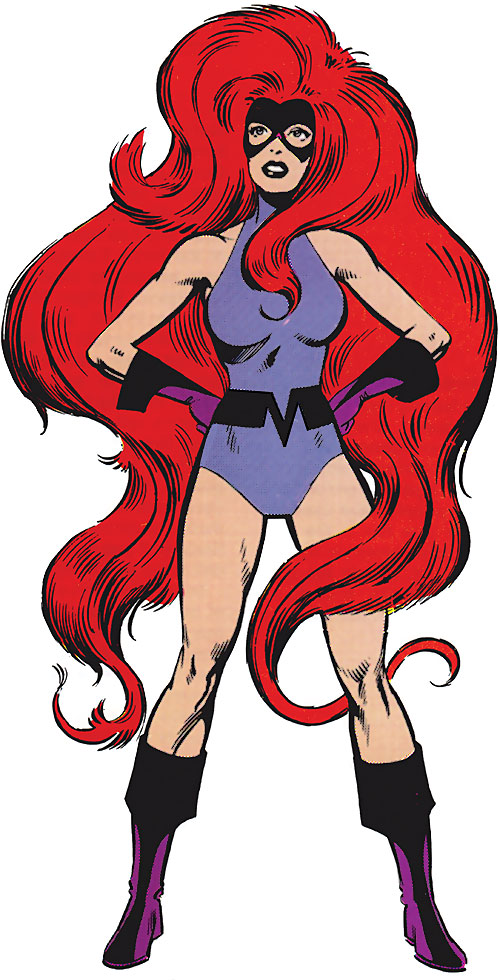
6) Medusa: The queen of the Inhumans has one of the most striking appearances in all of comicdom.  And as far as powers go, Medusa's living hair has to be the strangest example.  Like Thundra, Medusa got her start as a villain alongside the Frightful Four and faced the FF and later Spider-Man.   Revealed to be a noble Inhuman, her character slowly morphed from a wild criminal to a more nuanced nemesis and ultimately a confidant.   Her time as a replacement member on the Fantastic Four (following that of her sister Crystal) sticks with me as part of a great time for comics.   Her relationship with Reed Richards, though subtle and never realized fully, had me completely entertained.  I had partly hoped that Sue would leave the Baxter Building for Namor and Reed and Medusa would become a couple.  Medusa's ability to deal with Reed's brainiac aloofness said all that needed to be said about the character.  She was smart and strong willed and a leader.  In the long run, Medusa disappeared back into the Inhumans (a team that never really shines when put in the spotlight).  Visually, when her hair is in action, Medusa is perfect for the comic book medium.  Although she appears regularly in the Marvel Universe including a stint on a new FF with Ant-Man, I think her heyday was back in the Bronze Age when she could have really emerged as a powerful character.


 So there you have it BitBA fans; that is my list of under-appreciated Marvel creations.  Who would you add to the list and who would you take away?   Who deserves more air time, and who deserves to be put to pasture?

I am looking forward to your comments today, so let the opinions fly.  Oh, and please keep input limited to Marvel creations  as we will explore DC and Charlton at a later date.  Cheers all!


You Might Also Like --

Here are some related posts: